
How to Remove a Hunchback (Dowager’s Hump) in Burleigh Heads
Gold Coast Neck Hump Correction | Burleigh Biomechanics
If you’re searching “how to remove a hunchback” or “how to fix neck hump,” you’re probably noticing a visible bulge at the top of your spine.
It may look like:
A rounded upper back
A lump at the base of the neck
Forward head posture
A “dowager’s hump” developing over time
And you may have already tried stretching, massage or generic hunchback exercises.
But the hump remains.
Here’s why.
A hunchback posture is rarely just a tight upper back.
It’s a whole-body compensation pattern.
At Burleigh Biomechanics, we treat neck hump correction as a load distribution issue — not a cosmetic one.
What Is a Hunchback or Dowager’s Hump?
A hunchback posture (often called a dowager’s hump) is usually a visible prominence at the cervicothoracic junction — where your neck meets your upper back.
Biomechanically, it often reflects:
Rib cage compression
Forward head compensation
Reduced thoracic extension
Pelvic misalignment
Asymmetrical gait mechanics
Chronic flexion loading
In other words, the hump is not the root cause.
It’s the result of long-term mechanical stress.
Trying to “remove hump neck” without addressing global movement patterns rarely works long-term.
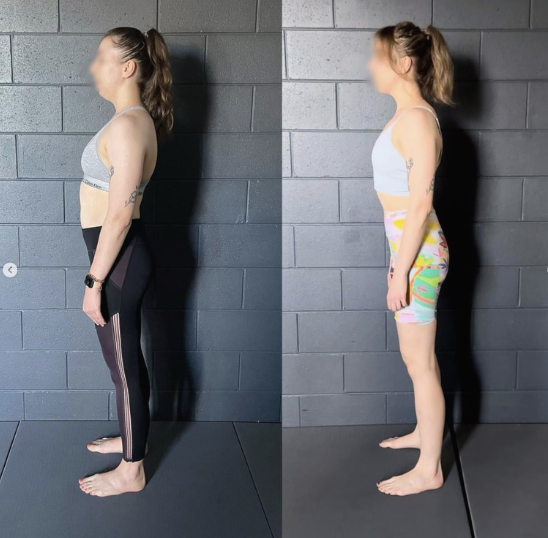
Why Neck Hump Correction Exercises Often Fail
Search results for “hunchback cure exercises” usually show:
Upper back stretches
Shoulder retraction drills
Chin tucks
Foam rolling
These can reduce tension temporarily.
But they don’t reorganise how your body handles gravity.
If your pelvis rotates forward during walking, your rib cage compensates. If your rib cage collapses, your head moves forward. If your head moves forward, the upper spine adapts.
The hump is a downstream adaptation.
Not an isolated problem.
The Gold Coast Lifestyle & Neck Hump Patterns
Living in Burleigh Heads and the broader Gold Coast creates specific stress patterns:
Long hours at desks
Driving coastal routes
Surfing with rotational dominance
Gym training without rotational balance
Phone use in flexed positions
These habits reinforce forward head posture and thoracic compression over time.
Neck hump correction must account for these lifestyle factors — not just stretch what feels tight.
How to Remove a Hunchback — The Structural Reality
If you want to know how to get rid of a neck hump permanently, the answer is not:
“Do more upper back exercises.”
The real question is:
How can the body reorganise force more efficiently?
Effective hunchback treatment requires improving:
1. Pelvic Mechanics
The pelvis determines spinal orientation.
If the pelvis is anteriorly tilted or rotated, the thoracic spine compensates. Over time, this influences upper back shape.
Correcting hunchback posture starts from the base — not the neck.
2. Rib Cage Expansion
Many people with a visible hump have chronic rib cage compression.
Breathing becomes shallow and asymmetrical.
The upper back stiffens.
The neck protrudes forward.
Improving rib cage mechanics is central to neck hump correction.
3. Thoracic Rotation
Humans are rotational beings.
When thoracic rotation is limited or biased to one side, the upper spine stiffens.
A stiff thoracic spine often presents visually as a hunchback.
Improving rotation changes shape over time.
4. Gait & Load Transfer
Your walking pattern shapes your spine daily.
If every step reinforces asymmetrical load transfer, the spine adapts accordingly.
At Burleigh Biomechanics, gait analysis is essential in hunchback treatment.
Posture reflects movement.
Movement reflects load.
Load shapes structure.
Can You Actually Remove a Dowager’s Hump?
If the hump is purely postural and load-driven, change is possible.
If structural degeneration or osteoporosis is present, full reversal may not be realistic — but mechanical improvement can still reduce progression and discomfort.
This is why assessment matters.
Not all hunchback posture is the same.
Not all neck humps are created equal.
Hunchback Exercises vs Biomechanics-Based Correction
Generic exercises for humpback focus on isolated muscle activation.
Biomechanics-based correction focuses on:
Whole-body coordination
Rotational balance
Breathing integration
Load symmetry
Progressive adaptation
You don’t “flatten” the hump.
You reorganise the system.
And the visible structure adapts gradually.
When to Seek Neck Hump Assessment in Burleigh
If you’re in:
Burleigh Heads
Miami
Palm Beach
Varsity Lakes
Broadbeach
Southern Gold Coast
and you’re noticing:
A growing bulge at the top of the spine
Persistent upper back tightness
Forward head posture
Chronic neck strain
guessing your way through exercises may delay structural change.
At Burleigh Biomechanics, hunchback posture assessment includes:
Structural alignment analysis
Thoracic mobility review
Pelvic positioning evaluation
Gait assessment
Load distribution mapping
Neck hump correction begins with understanding how your body organises itself under gravity.
Final Thoughts
How do you remove a hunchback?
Not by forcing your shoulders back.
Not by stretching endlessly.
Not by chasing tension.
You remove a hunchback by improving how your body distributes load.
The hump is an adaptation.
Change the mechanics, and structure follows.
If you’re on the Gold Coast and searching for long-term neck hump correction, start with biomechanics — not random exercises.